Release page
Format: Vinyl / Digital
Release Date: May 8, 2026
About
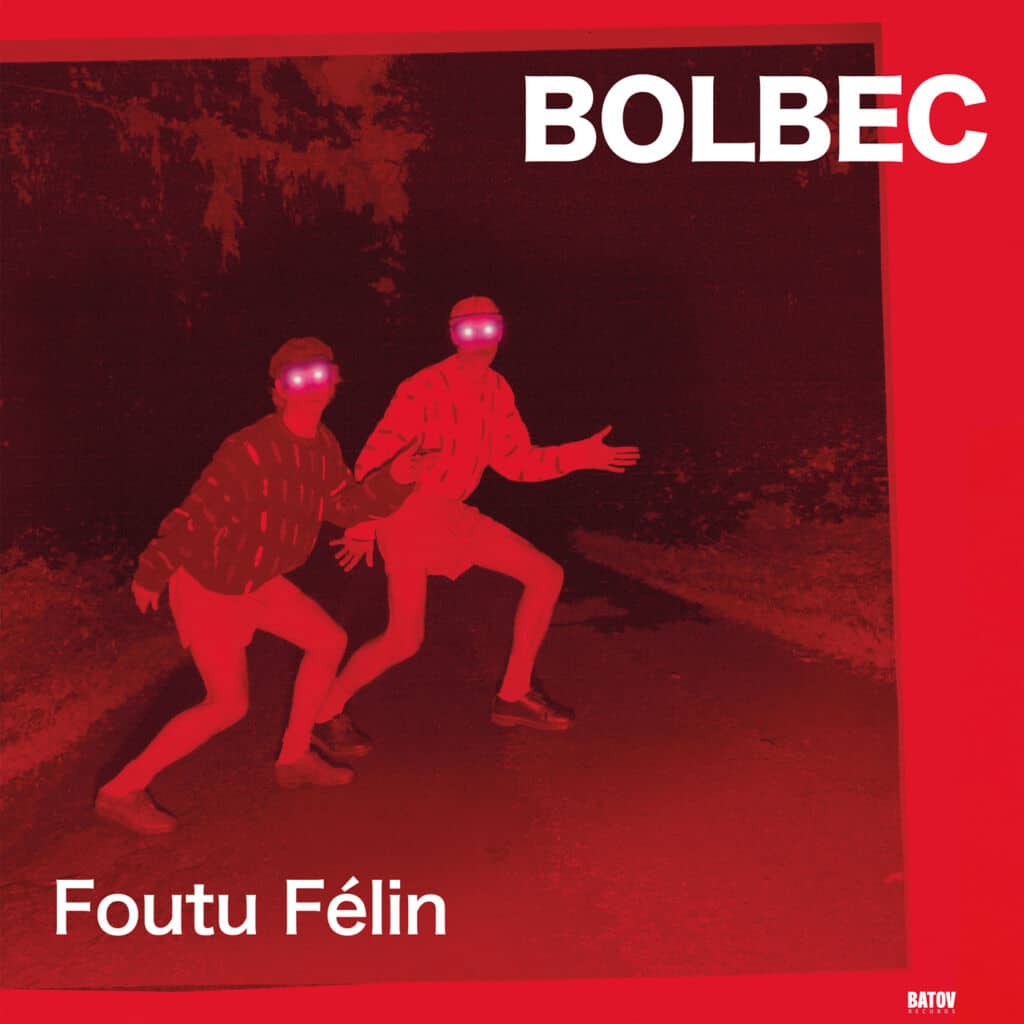
Foutu Félin
by Bolbec
FFO: SVEN WUNDER, JIMI TENOR, JANKO NILOVIC & THE SOUL SURFERS
The Bolbec duo return with their sophomore album Foutu Félin, a richly cinematic collection of instrumental music that unfolds like an imaginary soundtrack, melodic, tactile and transportive. The record is inspired as much by the cut-and-paste production techniques of Portishead and the Beastie Boys as by the legendary composers of le cinéma français and il cinema italiano.
Following directly from their debut Victime De L’aube, Foutu Félin feels like a continuation rather than a departure, a second reel instead of a reset. Axel Concato and Barth Corbelet each wrote five pieces independently, deliberately exploring as instinctively and introspectively as possible before reshaping their embryonic ideas together into bigger, brighter compositions, uncovering hidden humour along the way.
Cinema remains Bolbec’s primary language. “We always think in movie scenes”,, they explain. Barth points to Alberto Iglesias as a key influence, while Axel draws inspiration from the melodic logic of film scores from the 60s to the 80s, where characters carried themes and melody mattered as much as atmosphere. In contrast to contemporary soundtrack trends that prioritise texture over tune, Bolbec consciously foreground melody, harmony and rhythm in search of a personal musical signature.
That philosophy extends to the album’s French-language titles, which act as scene headings rather than explanations. Often playful and sometimes absurd, names such as ‘Café Frappé’, ‘Foutu Félin’ and ‘Le Prof de Gong’ sound like fragments of half-remembered films, inviting listeners to project their own narratives.
The album opens with ‘Café Frappé’, written in a single night by Axel. A clear nod to Morricone’s The Sicilian Clan, it also hints at French classical minimalism and the restrained tension of Portishead. Minimal at first, it expands through shifting orchestration as the same theme repeats, following a scene as it subtly evolves.
‘En Voiture’ plays like the opening shot of a road movie. Inspired by Ravel’s Boléro, it cycles patiently through two long themes, stretching repetition until it almost disappears. Classical structure drifts into jazz phrasing, with drummer Tim Giles sustaining its slow-burn momentum before flautist Gareth Lockrane improvises freely as the melody gradually falls away.
The title track ‘Foutu Félin’ leans into humour. Built around a buoyant walking bass, it imagines a feline character strutting somewhere between slapstick animation and jazz club swagger. The track subtly recalls the walking bass motif from the title piece of Victime De L’aube, reinforcing the sense that both albums inhabit the same cinematic universe.
‘Le Prof de Gong’ unfolds like a classic European score cue. Beginning as a simple guitar sketch, it grows into a richly layered waltz featuring banjo, piano, and wordless but melodic scat singing recalling the ethereal vocals of classic Piero Umiliani scores. A single melodic idea is reinterpreted across shifting moods, nodding to Morricone, Legrand and John Barry, in the process.
Elsewhere, recurring characters and locations appear. ‘Fanny’ began life as a vocal-led piece and survived Bolbec’s original plan to avoid vocals entirely thanks to its fragile, Robert Wyatt-like charm. A second version, ‘Fanny au Phare’, reimagines the same figure by the sea, windswept and romantic, with a faint Wuthering Heights atmosphere. Barth’s vocal is initially replaced by a drunken, sax-like Juno synth, before giving way to Vincent Défossé’s more sober trumpet. In the final chapter, Ross Stanley’s piano riffs drift close to Tyner/Coltrane’s ‘My Favourite Things’, before twisting back around into the opening motif.
Much of Foutu Félin was sketched at home before being taken to Fish Factory Studio in the UK, where musicians were encouraged to interpret and improvise freely. Performances were then carefully edited and reshaped, closer in spirit to cut-and-paste production than traditional jazz recording. Feel consistently took priority over technical perfection.
Returning players Tim Giles, Riaan Vosloo, Ross Stanley and Gareth Lockrane are joined by saxophonist James Allsop, whose contribution became a defining surprise, notably on ‘Ponto Final’. Additional recordings were completed in Rouen, with final mixes by Axel mastered by Sean Joseph in Bristol, whose sense of warmth and acoustic space helped shape the album’s sound.
Ultimately, Foutu Félin confirms Bolbec’s identity. Music that feels like the beginning of a story. Less theatre, more cinema. Close your eyes, the film is already rolling.
credits
released May 8, 2026
All tracks written and produced by Axel Concato and Barthélémy Corbelet
Saxophone – James Allsopp (3, 5, 6, 9)
Flutes – Gareth Lockrane (3, 4, 7)
Piano – Ross Stanley (7, 8 )
Double Bass – Riaan Vosloo (All tracks except 1)
Drums – Tim Giles (All Tracks)
All recorded by Benedic Lamdin at The Fishmarket, London
Trumpet – Vincent Défossé (6, 8, 10)
French Horn – Po Goal (10)
Cello – Yoann Le Dantec (1, 3, 5, 6)
Violin – Teona Kharadze (1, 3, 5, 6)
And other vocals and instruments performed by Bolbec
at rue Pigeon and La Mama Studio, Rouen
Strings arranged by Bolbec and Yoann Le Dantec
Mixed at La Mama Studio by Axel Concato
Mastered by Shawn Joseph at Optimum Mastering, Bristol
Cover Photography by Clémence Demesme
Design by Olivier Marquézy
℗ © Batov Records 2026 | BTR136
www.batovrecords.com
Distributed by !K7 Music